Tampilkan postingan dengan label japan fun. Tampilkan semua postingan

Great Judo Girl from Japan

After seeing this image you should know.. be ware there in Japan if you want to make something evil.. ^^


Japanese Girl doing German suplex to thief...  very awesome...  its pics from a video cctv in japanese apartement

  • Digg
  • Del.icio.us
  • StumbleUpon
  • Reddit
  • RSS

Daishogun Shrine (大将軍神社), Kyoto ^0^)/

Well...I first visited Kyoto in the late summer of 1984.  That was a million years ago.  For you Kyoto long-timers, please note that I came into town on the Keihan Line when it still ran above-street, right down the other side of Kawabata-dori, paralleling the Kamogawa. Of course with Kyoto being some 1250 years old, a little 25 year period’s but a blip in time for that ancient city.  Nevertheless, for me it was a long time ago.  And I’ve been back many,  many,  many times over the years.

Kurodani Temple. An "old" Kyoto haunt for me. August 2011.
That’s why I always enjoy (and which is part of why Kyoto so intrigues me) running into something new.  Something new for me, that is, usually not for Kyoto.  Moreover, it can be a little embarrassing when that “new” thing is not exactly hidden-away but, in fact, a few steps away from a street I’ve walked down hundreds of times.  Am I that non-observant, or am I just so “focused” that I tend to tune-out what’s not on my mind and in my sights?  I’ve salve my ego by thinking the latter, but knowing that it’s more than likely the former.
Getting to Daishogun-Jinja.
Whatever the case may be about two months ago, That time as I walked down Sanjo Dori (“Third Avenue”) in the early evening from the direction of the Westin Miyako hotel towards Kawabata Dori and the Kamo River I spotted a little combination beer stand/izakaya on the corner of Sanjo and a side street on the left, 5 blocks up from where San-jo crosses Kawabata Dori and the Kamo River.  That corner place is “Harumi-ya” ( はるみ屋 in Japanese, which you can see in red on the sign below ).  Here’s what it looks like, looking left as one walks towards the Kamo River:
Harumi-ya. On San-jo, just up from Kawabata. August 2011.
When you take that left and walk down the side street, Harumi-ya will be on your right.  You only need to walk about 100 yards/meters to see Daishogun-Jinja (with Jinja meaning Shinto Shrine) on your left.  I had never before walked down this street, though I had passed it countless times.  The light was failing, on the back side of the gloaming, when I walked in and here’s what I saw:
Walking into Daishogun Jinja. Kyoto. August 2011.
Daishogun Shrine
As shrine complexes go, it’s smallish.  But it dates back to the Heian Period (794-1185), though assuredly rebuilt and updated dozens of times over a millenium.
A small sign in English tells the visitor that Daishogun (which means “Great Generalissimo”) Jinja enshrines Susanoh no Mikoto, “a complex, composite deity in Japanese mythology” (says the sign).  This is somewhat funny because I’m thinking writing out legend of Susanoh no Mikato was simply too much of an English chore for the city official who wrote the sign to tackle.  Here’s a summary of Susanoh no Mikato’s tale:
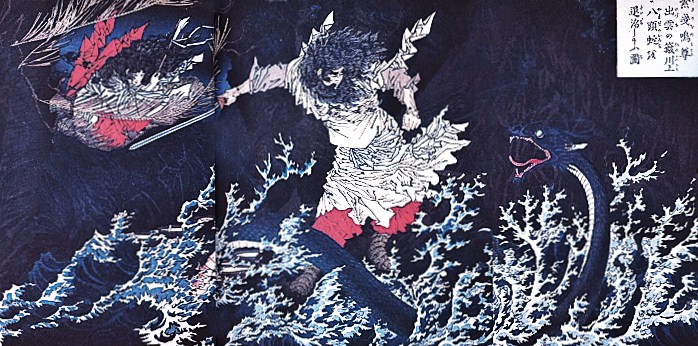
In Shintō mythology Susano’o was the younger brother of the sun goddess Amaterasu. The legend goes that as a result of his unruly behaviour, Amaterasu hid herself in a cave, thus bringing darkness and winter to the world. Susano’o was banished from the High Celestial Plain to Izumo Province in western Japan. Here he killed the eight-headed and eight-tailed serpent (yamata no orochi) and rescued Princess Kushinada. Afterwards he found in the dragon’s tail the sword which later became part of the regalia of the Japanese Imperial family.  Source.  A deeper account of the legend is here, in the Wiki.
Here’s a picture, a wood block print, of Susanoh no Mikato battling the dragon (bringing St. George to mind):
Susanoh no Mikato battles the dragon.
.
Also enshrined at Daishogun Jinja is the spirit of Kaneie Fujiwara, a Heian Period courtier.  The little sign at the entrance also says, and I quote verbatim:  “The scene of the legend that tells Yorimasa Minamoto killd a monster Nue.”  Yorimasa Minamoto was a late-Heian Period poet, courtier and warrior.  He was a historical figure, but his exploits became the stuff of legend, including his killing a Nue, a mythical beast, nasty monster comprised of bits of several animals.  Here’s a print from around 1840 of Yorimasa Minamoto (L) and Ino Hayata Tadazumi (R) killing a Nue:
Yorimasa Minamoto (R) & Ino Hayata Tadazumi killing a Nue.
Apparently one can see a painting of Yorimasa slaying a Nue at Daishogun Jinja, but as it was getting dark I didn’t have much time to look around for it.  I’ll be sure to look for and find it next time I’m there.  I also plan to update this post and add details to the photos below as I study and learn more about this ancient shrine.  Following are photos I took (with a “Droid” smartphone) as I strolled around Daishogun Jinja, just a block away from San-jo, one of Kyoto’s main streets, but here, in another world. . .
.
.
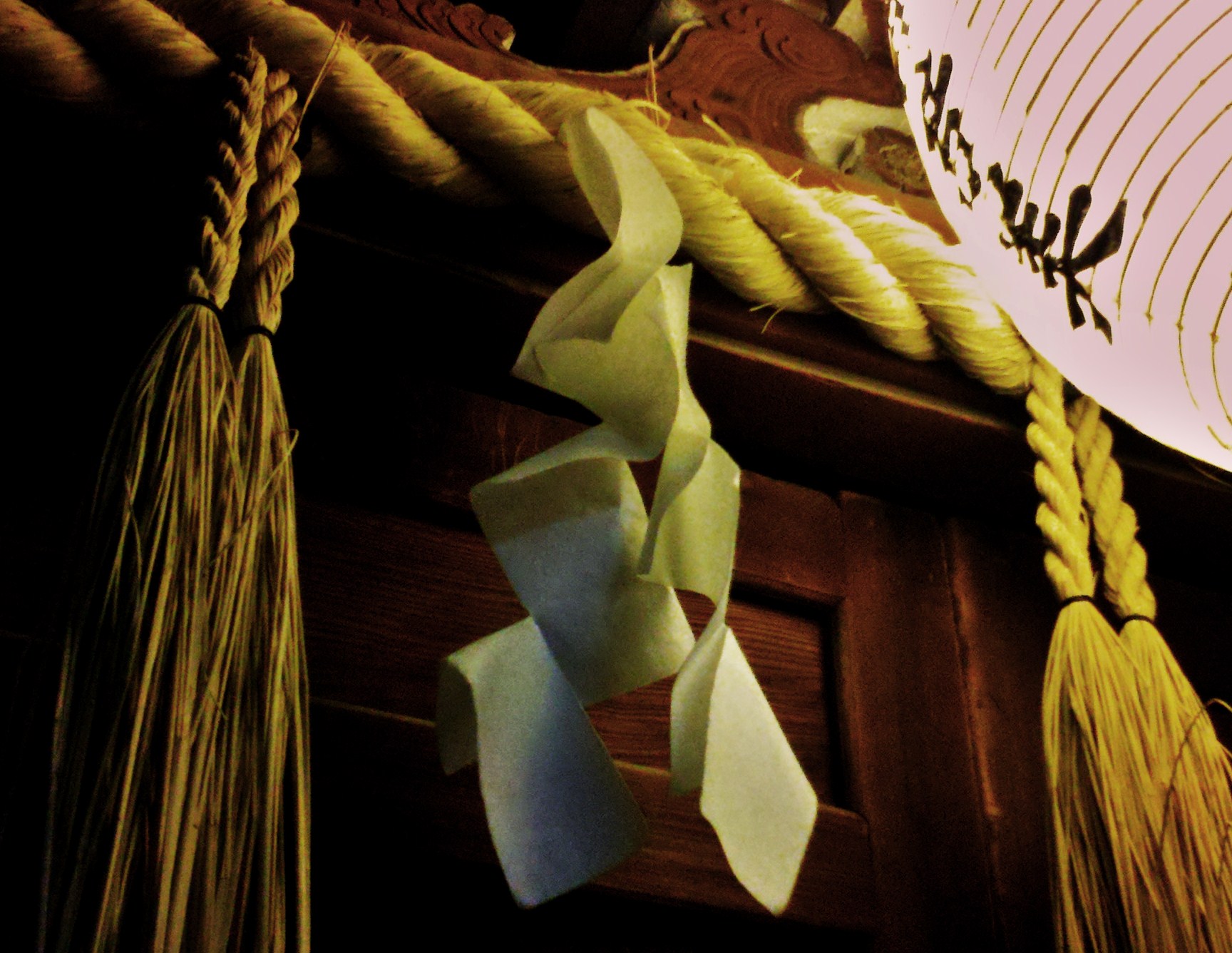
Above:  Close up, detail, of “shimenawa (special plaited rope) and shime (strips of white paper).  Placed at the entrances of holy places to ward off evil spirits, or placed around trees/objects to indicate presence of kami. Made of rice straw or hemp, the rope is called nawa . The pieces of white paper that are cut into strips and hung from these ropes (often hung from ropes on Torii gates as well) are called shime 注連 or gohei; they symbolize purity in the Shintō faith.”  The foregoing is a quote from this excellent site on Shinto.
.
.
.
.
.
.
.
Kitsune. The White Fox and servant of Shinto Deity Inari.
.         .         .
Here’s the view from in front of Daishogun Jinji, looking up the street towards San-jo Dori .  .  .
Daishogun Jinja's just to my right. Looking up the street towards San-jo Dori. Kyoto. August 2011.

  • Digg
  • Del.icio.us
  • StumbleUpon
  • Reddit
  • RSS

Indoor Skydiving - Japanese Fun solution using Google maps

http://farm3.static.flickr.com/2245/2414395273_ed6c71d8ee.jpg

This one is the solution if you fear to do the real skydiving...
Did you beginner? Have a fear of skydiving? or want to try something safer and closer to ground first?  These Japanese otaku simulation game have found a fun and silly solution to allay your fears. lets try it..

https://blogger.googleusercontent.com/img/b/R29vZ2xl/AVvXsEjImvKeeR9f4uLof64DiWpAljOUdjb-BYudgiPme4E0cbeJkTrvKYyyCcaqhD5xk7ecP9jhIRfDib5wKKXtDVuAGUuG9IwPigzocWvUeFM4_peTtYluXcNTz-FU4vjIykxJJ9KY2g_Ed3Tk/s1600/Google_Demo_Slam_Skydiving_01.png

The guys mounted a projector vertically so it shined on the floor. there they put blue plastic on the floor and walls and painted clouds on the walls for effect ,really amazing you know... The two skydivers were then harnessed up and hung from the ceiling as if they were diving.

https://blogger.googleusercontent.com/img/b/R29vZ2xl/AVvXsEiOubMz_tEC8TIaW1j_ffTVN_bOK8MVoK2gVl7syPrpKxT9QWhuwGo7ejTuOnAKSm2oH-VpGVqUX98EnNRU4f66MpsP0f5lSyZqRfbe9Yd2DM06bk3PKImucvu-fk1vefqDfyGax_X13dIF/s1600/Google_Demo_Slam_Skydiving_02.png

The projector output a Google Map image of Waikiki, Oahu, Hawaii on the floor and as the map was zoomed, it looked like the duo was actually coming closer to the ground. To make things more realistic they used a super fan to flap the hair and clothing around and hosed them with a fire extinguisher to make it seem like they were going through clouds. its makes you really looks like fall from the sky..amazing.. wow..

check the video :

  • Digg
  • Del.icio.us
  • StumbleUpon
  • Reddit
  • RSS

Japanese virtual dinner for lonely man


If you feel lonely with no girls arround or you want to have dinner with japanese girl.. this one can full fill your dreams... yeah.. Japanese virtual dinner.. is so good with so many cute girl you can choose..


Let’s face it, well.. no one really likes eating alone all the time.  That’s why Oshokuji no Jikan 素人・THEお食事の時間~私といっしょに食べようよ~ is a DVD series aimed at lonely  otaku guys who either work all day, have no friends or have no social skills to land a date or a combination of all three and offcourse its also for someone gaijin / non japan that want to have dinner with japanese girls ^^. Luckily for them, the folks at K-Network produced a 3 (three) DVD virtual dinner date series where  the viewer pretends he’s eating a meal with a (girl) friend. Yatta !!


The marketing blurb on the DVD says "あなたは、もはや一人で食べるはありません / Anata wa, mohaya hitori de taberu ni wa arimasen " or “you no longer have to eat alone”.  Each DVD is hour long and there are 3-5 different girls featured eating a variety of foods with engaging in various chit chat and conversation.


素人・THEお食事の時間~私といっしょに食べようよ~

The series we think can be improved if they had used gorgeous gravure idols like Anri Sugihara or JAV idols like Maria Ozawa instead of amateur ordinary gals! hahahha...

  • Digg
  • Del.icio.us
  • StumbleUpon
  • Reddit
  • RSS

Autumn in japan really Awesome


Autumn in Japan

Really Awesome..Colorful leaves (koyo) are to the Japanese autumn what cherry blossoms /sakura are to spring. The viewing of autumn leaves has been a popular activity in Japan for centuries and today draws large numbers of travelers to famous koyo spots both in the mountains and in the cities.
Each year, starting in mid September, the "koyo front" slowly moves southwards from the northern island of Hokkaido until it reaches the lower elevations of central and southern Japan towards the end of November. Some trees around Tokyo and Kyoto remain colorful into early December.
Guide to Autumn Colors:

http://www.1adh.com/2007/1120.jpg

Autumn is a great time to visit Japan with the leaves all turning gold, red and brown really awesome.  Not too hot and not too cold, it’s a great time of year for a visit.  Book your flight now! enjoy ^^

  • Digg
  • Del.icio.us
  • StumbleUpon
  • Reddit
  • RSS

Osaka At night

Osaka (大阪 Ōsaka?) is a city in the Kansai region of Japan's main island of Honshu, a designated city under the Local Autonomy Law,about the capital city of Osaka Prefecture & also the biggest part of Keihanshin area, which is represented by 3(three) major cities of Japan, Kyoto, Osaka and Kobe. Located at the mouth of the Yodo River on Osaka Bay, Osaka is the third largest city by population after Tokyo (special wards) and Yokohama. Keihanshin is the second largest area in Japan by population and 1 (one) of the largest metropolitan areas highly ranked in the world, with nearly 18 million people,[1] and by GDP the second largest area in Japan and the seventh largest area in the world.

Well..lets take a look..A panoramic view over the city from Umeda Sky Building


Historically the commercial centre of Japan, Osaka functions as one of the command centers for the Japanese economy. The ratio between daytime and night time population is 141%, the highest in Japan, highlighting its status as an economic center.[2] Its nighttime population is 2.6 million, the third in the country, but in daytime the population surges to 3.7 million, second only after Tokyo. (Totalling the Special wards of Tokyo, which is not a single incorporated city, for statistical purposes. See the Tokyo article for more information on the definition and makeup of Tokyo.) Osaka used to be referred to as the "nation's kitchen" (天下の台所 tenka no daidokoro?) in feudal Edo period because it was the centre of trading for rice, creating the first modern future exchange market in the world.[3][4][5][6]

Osaka at night

At night Osaka can being more great than when its sun shining.. well.. this city will always awake and never being empty.. and if you visit some club night it will be more good find some sexy ladies having fun there


Pub Crawl, Bar Tour, Bar Hopping Party… whatever you want to call it, Osaka has it. 101 is a blending of local partiers and travelers, mixing together a regular monthly pub crawl with special events. Every 4th Saturday we hit up 7 bars and clubs, it’s a wide look into Osaka’s Nightlife, ranging from traditional pubs, to fusion bars, to after hours clubs.  The first saturday of every month sees the small bar pub crawl, hitting up the smaller and less known bars around town.  It’s a good chance to see some of the underground scene in Osaka.  Whether you like meeting new people, getting spastically drunk, checking out new venues or All of the Above, 101 is the party for you. Reserve for a 500 yen discount at info@osakanightlife101.info  
はしご酒パーティーはツアーガイドが皆さんを7箇所のバーやクラブに連れて行き、楽しく飲み明かすインターナショナルパーティーです。

Osaka 大阪 is the second largest city in Japan after Tokyo.  Here are some great photos of the Osaka skyline at night. enjoy..
 ,

osaka at night


  • Digg
  • Del.icio.us
  • StumbleUpon
  • Reddit
  • RSS

Oshikko Inu Peeing Dog robot


This was one of weird stuff there in Japan..yeah..some cute toy dogs from Japan.  there was 3 type and name

http://www.strapya-world.com/pic/2010/osikko-inu03.jpg

These cute Oshikko Inu puppies  are not toilet trained house dogs as they will drip on your floor as they wobble around!  hahahhaa.. All you need to do is put Oshikko Inu’s back legs into his water bowl, then turn his tail a little bit to make sure he has enough water saved up. There is a little knob located on the right leg, and he will start walking around once you twist that knob. There are 3 (three) dogs to choose from Buchi, Cha and Mayu.   Cost is about US$15. Perhaps something the girlfriend will like?

  • Digg
  • Del.icio.us
  • StumbleUpon
  • Reddit
  • RSS

japan funny - Oppai ga Ippai children’s song


This one is so funny bout japanese song...yeah.. Oppai ga Ippai ^^
Oppai ga Ippai おっぱいがいっぱい) is a popular children’s song from the 1980s which  literally means ‘full of breast’ in Japanese (wtf??) hahaha.  Below are some fun and wacky videos singing the praises to mother’s breast (milk).
http://farm4.static.flickr.com/3505/3216355492_e6c39e64ed.jpg
Above, some big oppai gravure idols Mai Nishida and Kana Tsugihara
Wow.. both is so cute and kawaiii... sugoii

Oppai ga Ippai Song

From Jpop trio Beee地区


high school boys performing Oppai ga Ippai

  • Digg
  • Del.icio.us
  • StumbleUpon
  • Reddit
  • RSS

Japan - Tokyo Disney Land


Tokyo DisneyLand
Allright... this time we'll talk about some fun place in tokyo japan... yups.. it was tokyo disneyland.. lets check it out.. !

Note : In this article: Features, Review, DisneySea, Getting There
東京ディズニーランド
Hours 8:00 - 22:00 (Opens at 9 on many weekdays. Check website)
Contact See website
Website Tokyo Disneyland (English)
Tokyo Disneyland (Japanese)
Holidays None
Entry Adult 5,800 yen (1 day passport)
Adult 10,000 yen (2 day passport)
Access [Train] From JR Tokyo Station: Follow the red signs for the Keiyou Line to the underground platform. Get off at Maihama.


Introduction Tokyo DisneyLand

Tokyo Disneyland was the first Disney resort to be opened outside of America.(wow) The theme park and its sister resort, DisneySea, are located next to Tokyo Bay in Urayasu, Chiba, Japan. Japan's magic kingdom opened on April 15, 1983. Much has changed around the park with resort hotels and even a second theme park being built to satisfy the needs of the millions that visit each year. The Tokyo Disney Resort is owned and operated by The Oriental Land Company which licenses Disney's characters. It and DisneySea are the only Disney theme parks not owned by Disney. Tokyo Disneyland places regularly as 1 (one) of the top 3 (three) most visited theme parks in the world.
Tokyo Disneyland - Entrance
Walt Disney Imagineering designed the Japanese version of Disneyland by reusing much of the layout and rides from the Anaheim park. Calling it just a copy isn't the right way to describe what has become a unique and successful park with its own history. The designers did take the opportunity during the planning phase to add more room to the open areas. As a result, the park is bigger at 114 acres but actually has fewer attractions. Around 85,000 people are admitted at once which sometimes still isn't enough. Amazing..
Tokyo Disneyland - Small World
The park is not only the magic kingdom but the American kingdom as well. The owners tried being independent of American influences (corporate and social) and nearly went bankrupt before realizing they needed a unique product that other Japanese theme parks couldn't match. And today, it has a distinct (for Japan) American feel. Many "cast members" are from abroad and most restaurants serve American food. Good American classics like curry flavored popcorn and pork cutlet burgers are sold in the park. Well, okay, some of the food is adapted to fit the local palette.


Features
Tokyo Disneyland's Cinderella Castle
The park is divided into 7 (seven) areas and the centerpiece of Tokyo Disneyland, like most Disney resorts, is Cinderella's Castle. and most famous rides from the original are recreated here as well. The areas are:
  • World Bazaar
  • Adventureland
  • Westernland
  • Critter Country
  • Fantasyland
  • Toontown
  • Tomorrowland
Tokyo Disneyland - Jungle Cruise
Notably missing from the original is New Orleans Square. The train ride also circles around Adventureland instead of the outside of the park. Added is a canopy over the main shopping area, World Bazaar, to deal with Tokyo's wetter climate.


Review
Tokyo Disneyland - Toon Town
The park is meticulously maintained and cleaned even by Disney's high standards. Rides look like new and spilled popcorn and drinks are gone by the next time you look. Japanese customer service is possibly better then you'll find any other real country but the magic kingdom manages to top it. The investment made in training and having good management clearly makes this park the superior experience that it is. Honestly, other than feeling a bit too open in some areas there is little to not recommend about Tokyo Disneyland.


DisneySea
Yeah..Disneysea..Located behind Tokyo Disneyland is a separate Disney theme park called Tokyo DisneySea. This aquatic theme park is separate from Disneyland and has been highly successful. It's aimed at a bit older audience. Two day passports can be bought to visit one and then the other on the next day.


Getting There
Tokyo Disneyland Cinderella Statue
The main way people in Japan reach Disneyland is from JR Tokyo Station. The Keiyou Line (京葉線) trains go directly to JR Maihama Station where the main entrance to Tokyo Disney Resort is. This line has an underground platform which is a fair distance under and away from the main platforms. Follow the red signs to get to the platform. Well it takes about 15 minutes to get to Maihama. Please check the Disney website for how to reach the park from other places.
The language spoken in Japan is Japanese but not knowing it isn't a barrier to having a good time in the park. Every sign and announcement is in Japanese and English. This is as much for visitors from other parts of Asia as it is for native speakers...so..dont forget to come if you visit Japan okay? see ya..

See Also: Tokyo DisneySea, Universal Studios Japan

  • Digg
  • Del.icio.us
  • StumbleUpon
  • Reddit
  • RSS

Japan is Fun for you to know...

Well yeah... Japan is fun... can you believe it? if can't.. You must! ahahahhaa...

Japan 日本 Nihon or Nippon 日本国  Nippon-koku or Nihon-koku) is an island nation in East Asia.[10] Located in the Pacific Ocean, it lies to the east of the Sea of Japan, China, North Korea, South Korea and Russia, stretching from the Sea of Okhotsk in the north to the East China Sea and Taiwan in the south. The characters that make up Japan's name mean "sun-origin", which is why Japan is sometimes referred to as the "Land of the Rising Sun" .


The English word Japan is an exonym. The Japanese names for Japan are Nippon (にっぽん?) About this sound listen and Nihon (にほん?) About this sound listen ; both names are written using the kanji 日本. The Japanese name Nippon is used for most official purposes, including on Japanese yen, postage stamps, and for many international sporting events. Nihon is a more casual term and is used in contemporary speech. Japanese people refer to themselves as Nihonjin (日本人?) and to their language as Nihongo (日本語?). Both Nippon and Nihon mean "sun-origin" and are often translated as Land of the Rising Sun. This nomenclature comes from Japanese missions to Imperial China and refers to Japan's eastward position relative to China. Before Nihon came into official use, Japan was known as Wa (?) or Wakoku (倭国?).[16]
The English word for Japan came to the West via early trade routes. The early Mandarin or possibly Wu Chinese (吳語) word for Japan was recorded by Marco Polo as Cipangu. In modern Shanghainese, a Wu dialect, the pronunciation of characters 日本 'Japan' is Zeppen [zəʔpən]. The old Malay word for Japan, Jepang, was borrowed from a Chinese language — Jih'pen'kuo [17]—, and this Malay word was encountered by Portuguese traders in Malacca in the 16th century. Portuguese traders were the first to bring the word to Europe[18]. It was first recorded in English in a 1565 letter, spelled Giapan

History

A Paleolithic culture around 30,000 BC constitutes the first known habitation of Japan. This was followed from around 14,000 BC (the start of the Jōmon period) by a Mesolithic to Neolithic semi-sedentary hunter-gatherer culture, who include ancestors of both the contemporary Ainu people and Yamato people,[20][21] characterized by pit dwelling and rudimentary agriculture.[22] Decorated clay vessels from this period are some of the oldest surviving examples of pottery in the world. Around 300 BC, the Yayoi people began to enter the Japanese islands, intermingling with the Jōmon.[23] The Yayoi period, starting around 500 BC, saw the introduction of practices like wet-rice farming,[24] a new style of pottery,[25] and metallurgy, introduced from China and Korea.[26]
The Japanese first appear in written history in the Chinese Book of Han. According to the Records of Three Kingdoms, the most powerful kingdom on the archipelago during the 3rd century was called Yamataikoku. Buddhism was first introduced to Japan from Baekje, but the subsequent development of Japanese Buddhism was primarily influenced by China.[27] Despite early resistance, Buddhism was promoted by the ruling class and gained widespread acceptance beginning in the Asuka period (592–710).[28]
The Nara period (710–784) of the 8th century marked the emergence of a strong Japanese state, centered on an imperial court in Heijō-kyō (modern Nara). The Nara period is characterized by the appearance of a nascent literature as well as the development of Buddhist-inspired art and architecture.[29] The smallpox epidemic of 735–737 is believed to have killed as much as one-third of Japan's population.[30] In 784, Emperor Kammu moved the capital from Nara to Nagaoka-kyō before relocating it to Heian-kyō (modern Kyoto) in 794.

Samurai

Samurai (?) is the term for the military nobility of pre-industrial Japan. According to translator William Scott Wilson: "In Chinese, the character 侍 was originally a verb meaning to wait upon or accompany a person in the upper ranks of society, and this is also true of the original term in Japanese, saburau. In both countries the terms were nominalized to mean "those who serve in close attendance to the nobility," the pronunciation in Japanese changing to saburai. According to Wilson, an early reference to the word "samurai" appears in the Kokin Wakashū (905–914), the first imperial anthology of poems, completed in the first part of the 10th century.[1]
By the end of the 12th century, samurai became almost entirely synonymous with bushi (武士), and the word was closely associated with the middle and upper echelons of the warrior class. The samurai followed a set of rules that came to be known as bushidō. While they numbered less than 10% of Japan's population[2] samurai teachings can still be found today in both everyday life and in modern martial arts such as kendō.


Following the Battle of Hakusukinoe against Tang China and Silla in 663 AD that led to a Japanese retreat from Korean affairs, Japan underwent widespread reform. One of the most important was that of the Taika Reform, issued by Prince Naka no Ōe (Emperor Tenji) in 646 AD. This edict allowed the Japanese aristocracy to adopt the Tang Dynasty political structure, bureaucracy, culture, religion, and philosophy.[3] As part of the Taihō Code, of 702 AD, and the later Yōrō Code,[4] the population was required to report regularly for census, which was used as a precursor for national conscription. With an understanding of how the population was distributed, Emperor Mommu introduced the law whereby 1 in 3–4 adult males was drafted into the national military. These soldiers were required to supply their own weapons, and in return were exempted from duties and taxes.[3] This was one of the first attempts by the Imperial government to form an organized army modeled after the Chinese system. It was called gundan-sei (軍団制) by later historians and is believed to have been short-lived.[citation needed]
The Taihō Code classified most of the imperial bureaucrats into 12 ranks, each divided into two sub-ranks, 1st rank being the highest adviser to the emperor. Those of 6th rank and below were referred to as "samurai" and dealt with day-to-day affairs. Although these "samurai" were civilian public servants, the name is believed[by whom?] to have derived from this term. Military men, however, would not be referred to as "samurai" for many more centuries.[citation needed]
In the early Heian period, the late 8th and early 9th centuries, Emperor Kammu sought to consolidate and expand his rule in northern Honshū, but the armies he sent to conquer the rebellious Emishi people lacked motivation and discipline, and failed in their task.[citation needed] Emperor Kammu introduced the title of Seiitaishogun (征夷大将軍) or shogun, and began to rely on the powerful regional clans to conquer the Emishi. Skilled in mounted combat and archery (kyūdō), these clan warriors became the emperor's preferred tool for putting down rebellions.[citation needed] Although this is the first time 'shogun' title is used, it was a temporal title and had not been accompanied with political power until 13th century, and at this time (7th to 9th century) the imperial court officials considered them to be merely military section under control of imperial court.
Ultimately, Emperor Kammu disbanded his army. From this time, the emperor's power gradually declined. While the emperor was still the ruler, powerful clans around Kyoto (京都) assumed positions as ministers, and their relatives bought positions as magistrates.[citation needed] To amass wealth and repay their debts, magistrates often imposed heavy taxes, resulting in many farmers becoming landless

Kamakura Bakufu and the rise of samurai

Originally the emperor and nobility employed these warriors. In time, they amassed enough manpower, resources and political backing in the form of alliances with one another, to establish the first samurai-dominated government.
As the power of these regional clans grew, their chief was typically a distant relative of the emperor, and a lesser member of either the Fujiwara, Minamoto, or Taira clans.
Though originally sent to provincial areas for a fixed four-year term as a magistrate, the toryo declined to return to the capital when their terms ended, and their sons inherited their positions and continued to lead the clans in putting down rebellions throughout Japan during the middle- and later-Heian period.
Samurai fought at the naval battle of Dan-no-Ura in 1185. Because of their rising military and economic power, the warriors ultimately became a new force in the politics of the court. Their involvement in the Hōgen in the late Heian period consolidated their power, and finally pitted the rival Minamoto and Taira clans against each other in the Heiji Rebellion of 1160.
The winner, Taira no Kiyomori, became an imperial advisor, and was the first warrior to attain such a position. He eventually seized control of the central government, establishing the first samurai-dominated government and relegating the emperor to figurehead status.
However, the Taira clan was still very conservative when compared to its eventual successor, the Minamoto, and instead of expanding or strengthening its military might, the Taira clan had its women marry emperors and exercise control through the emperor.
The Taira and the Minamoto clashed again in 1180, beginning the Gempei War which ended in 1185. The victorious Minamoto no Yoritomo established the superiority of the samurai over the aristocracy. In 1190 he visited Kyoto, and in 1192 became Seii Taishogun, establishing the Kamakura Shogunate, or Kamakura Bakufu. Instead of ruling from Kyoto, he set up the Shogunate in Kamakura, near his base of power. "Bakufu" means "tent government", taken from the encampments the soldiers would live in, in accordance with the Bakufu's status as a military government.[26]
Over time, powerful samurai clans became warrior nobility, or "buke", who were only nominally under the court aristocracy. When the samurai began to adopt aristocratic pastimes like calligraphy, poetry and music, some court aristocrats in turn began to adopt samurai customs. In spite of various machinations and brief periods of rule by various emperors, real power was now in the hands of the Shogun and the samurai.


Oda, Toyotomi and Tokugawa

Oda Nobunaga was the well-known lord of the Nagoya area (once called Owari Province) and an exceptional example of a samurai of the Sengoku Period. He came within a few years of, and laid down the path for his successors to follow, the reunification of Japan under a new Bakufu (Shogunate).
Oda Nobunaga made innovations in the fields of organization and war tactics, heavily used arquebuses, developed commerce and industry and treasured innovation. Consecutive victories enabled him to realize the termination of the Ashikaga Bakufu and the disarmament of the military powers of the Buddhist monks, which had inflamed futile struggles among the populace for centuries. Attacking from the "sanctuary" of Buddhist temples, they were constant headaches to any warlord and even the emperor who tried to control their actions. He died in 1582 when one of his generals, Akechi Mitsuhide, turned upon him with his army.

samurai

samurai fighting

Modernization

The relative peace of the Tokugawa era was shattered with the arrival of Commodore Matthew Perry's massive U.S. Navy steamships in 1853. Perry used his superior firepower to force Japan to open its borders to trade. Prior to that only a few harbor towns, under strict control from the Shogunate, were allowed to participate in Western trade, and even then, it was based largely on the idea of playing the Franciscans and Dominicans off against one another (in exchange for the crucial arquebus technology, which in turn was a major contributor to the downfall of the classical samurai).
From 1854, the samurai army and the navy were modernized. A Naval training school was established in Nagasaki in 1855. Naval students were sent to study in Western naval schools for several years, starting a tradition of foreign-educated future leaders, such as Admiral Enomoto.
French naval engineers were hired to build naval arsenals, such as Yokosuka and Nagasaki. By the end of the Tokugawa shogunate in 1867, the Japanese navy of the shogun already possessed eight western-style steam warships around the flagship Kaiyō Maru, which were used against pro-imperial forces during the Boshin war, under the command of Admiral Enomoto. A French Military Mission to Japan (1867) was established to help modernize the armies of the Bakufu.
The last showing of the original samurai was in 1867 when samurai from Chōshū and Satsuma provinces defeated the Shogunate forces in favor of the rule of the emperor in the Boshin War (1868–1869). The two provinces were the lands of the daimyo that submitted to Ieyasu after the Battle of Sekigahara (1600).
The Tokugawa Shogunate also isolated Japan until 1868 of when the Meiji restoration shifted power from the shogunate to the Imperial family.

 Modern era

On March 31, 1854, Commodore Matthew Perry and the "Black Ships" of the United States Navy forced the opening of Japan to the outside world with the Convention of Kanagawa. Subsequent similar treaties with Western countries in the Bakumatsu period brought economic and political crises. The resignation of the shogun led to the Boshin War and the establishment of a centralized state nominally unified under the Emperor (the Meiji Restoration).[39] Adopting Western political, judicial and military institutions, the Cabinet organized the Privy Council, introduced the Meiji Constitution, and assembled the Imperial Diet. The Meiji Restoration transformed the Empire of Japan into an industrialized world power that pursued military conflict to expand its sphere of influence. After victories in the First Sino-Japanese War (1894–1895) and the Russo-Japanese War (1904–1905), Japan gained control of Taiwan, Korea, and the southern half of Sakhalin.[40] Japan's population grew from 35 million in 1873 to 70 million in 1935.[41]

The Empire of Japan invaded other parts of China in 1937, precipitating the Second Sino-Japanese War (1937–1945). In 1940, the Empire then invaded French Indochina, after which the United States placed an oil embargo on Japan.[44] On December 7, 1941, Japan attacked the US naval base at Pearl Harbor and declared war, bringing the US into World War II.[45][46] After the Soviet invasion of Manchuria and the atomic bombings of Hiroshima and Nagasaki in 1945, Japan agreed to an unconditional surrender on August 15.[47] The war cost Japan and the rest of the Greater East Asia Co-Prosperity Sphere millions of lives and left much of the nation's industry and infrastructure destroyed. The Allies (led by the US) repatriated millions of ethnic Japanese from colonies and military camps throughout Asia, largely eliminating the Japanese empire and restoring the independence of its conquered territories.[48] The Allies also convened the International Military Tribunal for the Far East on May 3, 1946 to prosecute some Japanese leaders for war crimes. However, the bacteriological research units and members of the imperial family involved in the war were exonerated from criminal prosecutions by the Supreme Allied Commander despite calls for trials for both groups.[49]
In 1947, Japan adopted a new constitution emphasizing liberal democratic practices. The Allied occupation ended with the Treaty of San Francisco in 1952[50] and Japan was granted membership in the United Nations in 1956. Japan later achieved rapid growth to become the second-largest economy in the world. This ended in the mid-1990s when Japan suffered a major recession. In the beginning of the 21st century, positive growth has signaled a gradual economic recovery.[51] On March 11, 2011, Japan suffered the strongest earthquake in its recorded history; this triggered the Fukushima I nuclear accidents, one of the worst disasters in the history of nuclear power.[52]


Climate

The climate of Japan is predominantly temperate, but varies greatly from north to south. Japan's geographical features divide it into six principal climatic zones: Hokkaidō, Sea of Japan, Central Highland, Seto Inland Sea, Pacific Ocean, and Ryūkyū Islands. The northernmost zone, Hokkaido, has a temperate climate with long, cold winters and cool summers. Precipitation is not heavy, but the islands usually develop deep snowbanks in the winter. In the Sea of Japan zone on Honshū's west coast, northwest winter winds bring heavy snowfall. In the summer, the region is cooler than the Pacific area, though it sometimes experiences extremely hot temperatures because of the foehn wind. The Central Highland has a typical inland climate, with large temperature differences between summer and winter, and between day and night; precipitation is light. The mountains of the Chūgoku and Shikoku regions shelter the Seto Inland Sea from seasonal winds, bringing mild weather year-round. The Pacific coast experiences cold winters with little snowfall and hot, humid summers because of the southeast seasonal wind. The Ryukyu Islands have a subtropical climate, with warm winters and hot summers. Precipitation is very heavy, especially during the rainy season.[81]
The average winter temperature in Japan is 5.1 °C (41.2 °F) and the average summer temperature is 25.2 °C (77.4 °F).[82] The highest temperature ever measured in Japan—40.9 °C (105.6 °F)—was recorded on August 16, 2007.[83] The main rainy season begins in early May in Okinawa, and the rain front gradually moves north until reaching Hokkaidō in late July. In most of Honshū, the rainy season begins before the middle of June and lasts about six weeks. In late summer and early autumn, typhoons often bring heavy rain.[84]

Education

Primary schools, secondary schools and universities were introduced in 1872 as a result of the Meiji Restoration.[175] Since 1947, compulsory education in Japan comprises elementary and middle school, which together last for nine years (from age 6 to age 15). Almost all children continue their education at a three-year senior high school, and, according to the MEXT, as of 2005 about 75.9 percent of high school graduates attend a university, junior college, trade school, or other higher education institution.[176] The two top-ranking universities in Japan are the University of Tokyo and Kyoto University.[177][178] The Programme for International Student Assessment coordinated by the OECD currently ranks the overall knowledge and skills of Japanese 15-year-olds as sixth best in the world.[179]


  • Digg
  • Del.icio.us
  • StumbleUpon
  • Reddit
  • RSS
Related Posts Plugin for WordPress, Blogger...

Easy way to Earn Money